issue 001 · campaign EV-023
# Memorandum of Law

**To:** The Honorable Probate Judge, Franklin County
**From:** Law Clerk
**Re:** Construction of Article IV, Last Will and Testament of Helena Cartwright
**Date:** June 10, 2026

---

## I. ISSUE

What estates and future interests does Article IV of Helena Cartwright's will create; which of those interests, if any, violate the common-law Rule Against Perpetuities (RAP); and what is the state of the title to Blackacre after striking any void interests?

---

## II. RULE

### A. The Fee Tail in Franklin

Franklin has never abolished the fee tail. The devise "to A and the heirs of his body" creates an estate tail (fee tail) — a present possessory freehold estate that descends to the lineal blood descendants of the grantee. The tenant in tail holds a limited inheritance: the estate endures so long as the grantee's lineal issue survive. If the line fails (the tenant in tail dies without surviving issue), the fee tail terminates and the next estate in the chain takes effect. A fee tail is a vested estate; it is not subject to the Rule Against Perpetuities because no future vesting event is required.

### B. Contingent Remainders

A remainder is a future interest created in a transferee that is capable of becoming possessory upon the natural termination of the preceding freehold estate. A remainder is contingent if (i) it is given to an unascertained person, or (ii) it is subject to a condition precedent. Contingent remainders are subject to the Rule Against Perpetuities.

### C. The Common-Law Rule Against Perpetuities

Under the classical common-law Rule Against Perpetuities, no future interest is valid unless it must vest, if at all, not later than twenty-one years after some life in being at the creation of the interest. The measuring period is "lives in being plus twenty-one years." The test is what *might* happen, not what *does* happen — if there is any possible scenario, however improbable, in which the interest could vest beyond the perpetuities period, the interest is void *ab initio*.

Three corollaries control here:

1. **Fertile-Octogenarian Presumption.** Every person, regardless of age, sex, or medical condition, is conclusively presumed capable of bearing or begetting children. At common law this presumption is irrebuttable — medical evidence of sterility, menopause, or advanced age cannot defeat it.

2. **Unborn-Widow Presumption.** A devise to the "widow" of a named person is a devise to the person who is that person's spouse at death. Because the named person could divorce, remarry, or marry for the first time after the testator's death, the "widow" may be a person not yet born at the creation of the interest. The identity of the widow is therefore not ascertainable until the named person's death.

3. **Class-Gift Rule ("All or Nothing").** For a class gift, the entire interest is void if the interest of any potential class member might vest beyond the perpetuities period. The class must be closed *and* all conditions precedent must be satisfied within lives in being plus twenty-one years. It is not enough that some members might qualify within the period; if any conceivable class member might qualify too late, the entire gift fails. Under the "rule of convenience," a class closes when any member is entitled to distribution, but that doctrine operates at distribution, not at RAP analysis — the RAP "what might happen" test examines whether the class *could* remain open, or a condition *could* remain unsatisfied, beyond the period.

### D. Effect of Void Interests

A future interest that violates the Rule Against Perpetuities is stricken (void at creation). The remaining valid interests are given effect as though the void limitation had never been written. If removing a void limitation creates a gap, the undisposed-of interest falls into the testator's residuary clause or passes by intestacy.

---

## III. APPLICATION

### A. Classification of Interests Created by Article IV

Article IV reads:

> "I devise Blackacre to my son Arthur and the heirs of his body, and if Arthur's bodily line should ever fail, then to such person as shall be Arthur's widow for her life, and then to those of Arthur's grandchildren who shall attain the age of twenty-five years, in equal shares; but if no grandchild of Arthur lives to attain the age of twenty-five, then to the Rensselaer Historical Society, its successors and assigns, forever."

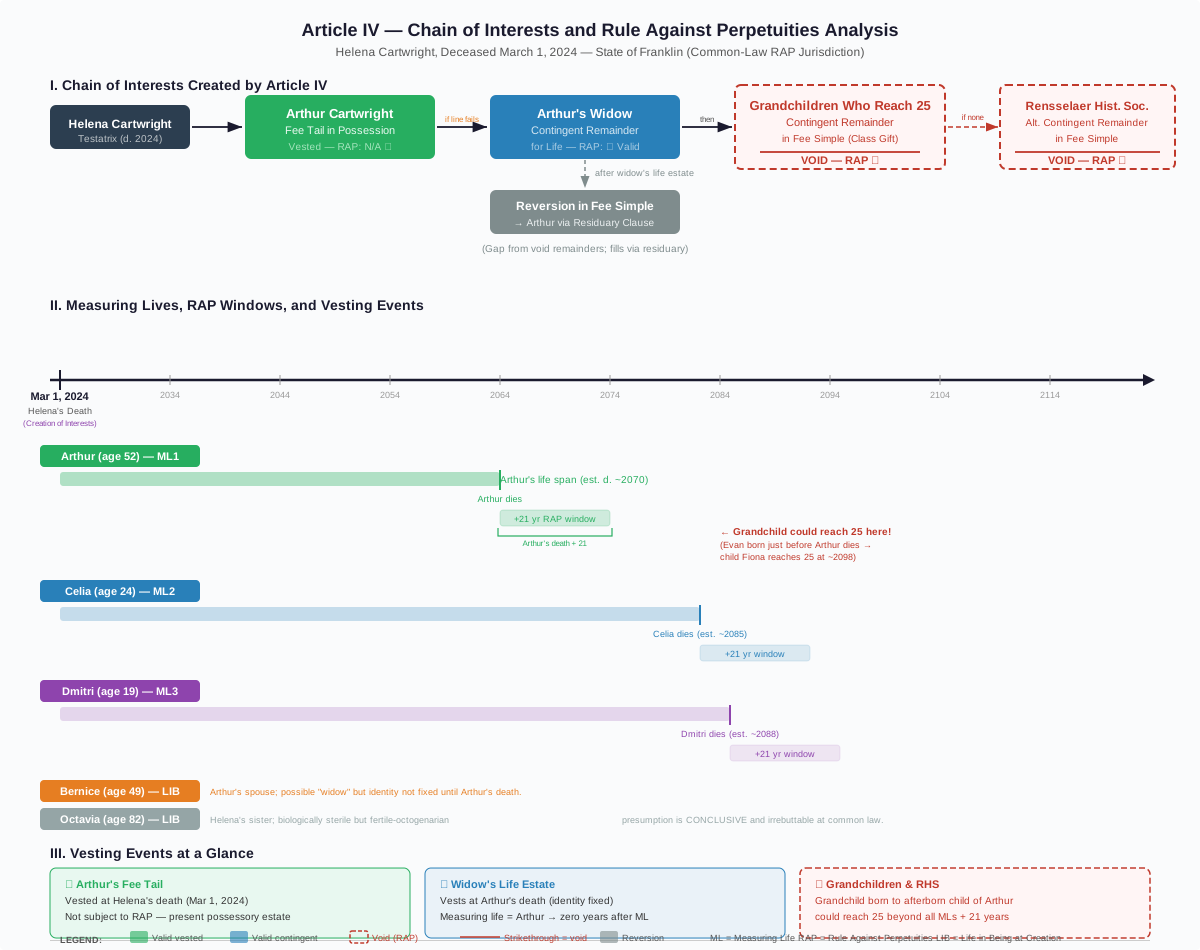
The clause creates four interests, arranged in sequence:

---

#### 1. Arthur Cartwright — Fee Tail in Possession

**Taker:** Arthur Cartwright (Helena's only child, age 52 at her death).

**Type:** Fee tail (estate tail) in possession. The language "to my son Arthur and the heirs of his body" is the classic formula for creating a fee tail at common law. Because Franklin has not abolished the fee tail, the devise takes effect as a fee tail, not as a fee simple absolute (as it would under modern statutes abolishing the fee tail) and not as a life estate (a construction some jurisdictions might apply by statute).

**Classification:** Vested present possessory estate. The fee tail is a present freehold interest. It is vested at Helena's death because Arthur is a named, living, ascertained taker, and no condition precedent must be satisfied before he takes possession. The only "contingency" — failure of Arthur's bodily line — is a limitation on the *duration* of the estate (a special limitation inherent in the fee tail), not a condition precedent to Arthur's interest.

**Legal effect of Franklin's retention of the fee tail:** In jurisdictions that have abolished the fee tail, this language would typically create a fee simple absolute in Arthur (by statute converting fee tails into fee simples). Because Franklin retains the fee tail, Arthur's estate is *limited* — it can endure only so long as his lineal descendants survive. If Arthur's bodily line fails, the fee tail terminates by its own inherent limitation, and the next estate in the chain becomes possessory. The continued existence of the fee tail in Franklin means that (a) Arthur cannot alienate the property in fee simple by a simple deed (though he could historically bar the entail by common recovery — a point the parties have not raised), and (b) valid remainders can follow a fee tail. The fee tail's status as a lesser estate than fee simple is what makes the downstream contingent remainders structurally possible.

---

#### 2. Arthur's Widow — Contingent Remainder for Life

**Taker:** "Such person as shall be Arthur's widow" (a person not yet ascertainable).

**Type:** Contingent remainder for life (life estate). This interest follows the natural termination of the fee tail and is limited to the widow's lifetime.

**Classification:** Contingent remainder. The interest is contingent for two independent reasons:
- **Unascertained taker:** The widow is the person who is Arthur's lawful spouse at Arthur's death. At Helena's death, Arthur is married to Bernice (age 49). But Arthur and Bernice could divorce, or Bernice could predecease Arthur, and Arthur could remarry — perhaps someone not born until after Helena's death. The identity of the widow is therefore not ascertainable at the creation of the interest.
- **Condition precedent:** The interest can become possessory only "if Arthur's bodily line should ever fail" — a condition that may or may not occur.

---

#### 3. Arthur's Grandchildren — Contingent Remainder in Fee Simple (Class Gift)

**Taker:** "Those of Arthur's grandchildren who shall attain the age of twenty-five years" (a class, open at Helena's death).

**Type:** Contingent remainder in fee simple absolute (or fee simple subject to executory limitation). The grandchildren take in equal shares.

**Classification:** Contingent remainder, and a class gift. The interest is contingent because no grandchild of Arthur exists at Helena's death (Celia, age 24, and Dmitri, age 19, are Arthur's children; neither is married; neither has children), and even when grandchildren come into being, each must satisfy the condition precedent of attaining age twenty-five. The class of "Arthur's grandchildren" is open — Arthur, at 52, could have additional children, who could in turn have more grandchildren.

---

#### 4. Rensselaer Historical Society — Alternative Contingent Remainder in Fee Simple

**Taker:** The Rensselaer Historical Society, a charitable corporation.

**Type:** Alternative contingent remainder in fee simple. It takes effect only if the condition precedent to the grandchildren's remainder fails — i.e., if no grandchild lives to attain age twenty-five.

**Classification:** Contingent remainder (or, depending on characterization, a shifting executory interest). It is contingent on the non-occurrence of an event (no grandchild reaching twenty-five), and the condition may not be resolved within the perpetuities period. For purposes of RAP analysis, it functions as an alternative contingent remainder.

---

### B. Application of the Rule Against Perpetuities

The perpetuity clock starts at Helena's death on March 1, 2024 (the creation of the interests). The measuring period is "lives in being at March 1, 2024, plus twenty-one years." The persons alive at Helena's death who bear on this analysis are Arthur (52), Bernice (49), Celia (24), Dmitri (19), and Octavia (82).

---

#### 1. Arthur's Fee Tail

**Not subject to RAP.** A fee tail in possession is a present vested estate. It requires no future vesting event. ✓ **Valid.**

---

#### 2. Arthur's Widow's Contingent Remainder for Life

**Measuring life:** Arthur Cartwright. The widow is identified at Arthur's death. When Arthur dies, the identity of the widow becomes fixed (or the interest fails for want of a widow). Because Arthur is a life in being at the creation of the interest, the widow's interest must vest (or fail) not later than Arthur's death — zero years after a life in being. This is well within the perpetuities period.

**The unborn-widow issue:** It is true that Arthur's widow could be a person not yet born at Helena's death (e.g., a woman born in 2025 whom Arthur marries in 2055). However, for the widow's interest *itself*, this does not pose a RAP problem. The interest vests *at Arthur's death*, not at some later date. Arthur is a life in being. The fact that the taker is presently unascertainable does not delay vesting beyond the measuring period; it simply means the interest is contingent until Arthur's death, which occurs within the measuring life.

**(b) Can Bernice be identified as "the widow" at Helena's death?** No. The devise to "such person as shall be Arthur's widow" is a devise to the person who is Arthur's lawful spouse at Arthur's death. Bernice is Arthur's spouse *now*, but she may not be Arthur's spouse at his death. She could predecease Arthur, or they could divorce before Arthur dies, and Arthur could remarry. Bernice cannot claim a present vested interest as "the widow" because her status depends on an event (Arthur's death) that has not yet occurred. At the creation of the interest, the widow is unascertainable; Bernice's claim is merely an expectancy. This is the classic unborn-widow analysis, and it confirms that the widow's interest is contingent, not vested — but it does not render the interest void under RAP.

✓ **Valid.**

---

#### 3. Arthur's Grandchildren's Contingent Remainder — VOID

This is a class gift to "those of Arthur's grandchildren who shall attain the age of twenty-five years." At Helena's death, the class has zero members, and the class remains open.

**The worst-case scenario under RAP:** The "what might happen" test requires one scenario in which a grandchild's interest could vest beyond the perpetuities period.

- Arthur, at age 52, is conclusively presumed fertile under the fertile-octogenarian presumption.
- Arthur could live another thirty years (to age 82). During that time, he could father a child (call the child "Evan") with Bernice (age 49 — also conclusively presumed fertile, despite her age) or with a new spouse.
- Evan is born, say, in 2053 — 29 years after Helena's death, and therefore not a life in being. (Only persons alive at the creation of the interest can serve as measuring lives.)
- Evan grows up and, at age 20, has a child (call the child "Fiona") — Arthur's grandchild.
- Fiona reaches age 25 and satisfies the condition precedent. This occurs roughly 29 + 20 + 25 = 74 years after Helena's death — and more than 21 years after the death of *any* life in being at Helena's death.
- Under the class-gift "all or nothing" rule, if the interest of *one* potential class member might vest too remotely, the *entire* class gift fails.

**Measuring lives:** The candidate measuring lives for the class gift are Arthur, Celia, and Dmitri (all lives in being). The worst-case grandchild (Fiona) is born to an afterborn child of Arthur (Evan) who is not a life in being. Fiona's interest could vest more than 21 years after the death of all three measuring lives. Therefore, the class gift is void.

**Is the class saved by the rule of convenience?** No. The rule of convenience closes the class when distribution can occur, but RAP examines the *possibility* that a class member born later could qualify too remotely. The class of grandchildren closes definitively at Arthur's death (no more children of Arthur can be born), and Arthur is a life in being. However, a grandchild born to Arthur's afterborn child could still *reach age 25* more than 21 years after Arthur's death. The condition precedent (attaining age 25) is not guaranteed to be satisfied within the measuring period. The class-gift rule requires both class closure *and* satisfaction of all conditions within the period.

**(a) Octavia's age and the fertile-octogenarian presumption.** Octavia is Helena's sister, age 82, biologically incapable of bearing children. Her age and medical condition do not excuse the fertile-octogenarian presumption for two independent reasons:

- **First**, the fertile-octogenarian presumption is *conclusive* at common law. Medical evidence of sterility, no matter how definitive, cannot rebut it. This is a rule of law, not a factual inference. Even if Octavia were the relevant person (she is not), her medical condition would be legally irrelevant.

- **Second**, Octavia is not a relevant actor in this fact pattern. She is not a taker under Article IV, she is not in the chain of Arthur's lineage, and her fertility (or sterility) has no bearing on whether Arthur (age 52) can have additional children. The critical fertile-octogenarian question concerns Arthur, not Octavia. Even if the presumption could be rebutted by medical evidence (which it cannot), Octavia's condition says nothing about Arthur's reproductive capacity.

The fertile-octogenarian presumption thus applies in full force to Arthur. He must be presumed capable of fathering additional children, and the RAP analysis must account for the possibility of afterborn children who produce afterborn grandchildren.

✗ **Void.** The entire class gift to Arthur's grandchildren is void for remoteness.

---

#### 4. Rensselaer Historical Society's Alternative Contingent Remainder — VOID

The RHS takes "if no grandchild of Arthur lives to attain the age of twenty-five." This is an alternative contingent remainder keyed to the same condition precedent as the grandchildren's remainder. It vests only if the condition precedent to the grandchildren's remainder is *not* satisfied.

**The RAP problem:** The RHS interest vests when it becomes certain that no grandchild will reach age 25. When can that certainty arise? Not before Arthur's death (which closes the class of Arthur's children). Even after Arthur's death, living grandchildren or the descendants of Arthur's living children could still attain age 25 — potentially more than 21 years after the death of all lives in being. If Arthur has children who survive him, those children could have grandchildren, and those grandchildren might reach age 25 decades after Arthur's death. Because the condition on which RHS's remainder depends might not be resolved within the perpetuities period, the interest fails.

Under the common law, alternative contingent remainders are tested independently. If both alternatives could vest beyond the period, both are void. The logic is symmetrical: if the grandchildren's remainder might vest too late, the alternative that depends on the grandchildren's remainder *failing* might also be indeterminate too late.

✗ **Void.**

---

### C. Summary of RAP Analysis

| Interest | Estate/Interest | Taker | Vested/Contingent | RAP Result |
|---|---|---|---|---|
| 1st | Fee tail in possession | Arthur Cartwright | Vested | ✓ Valid (not subject to RAP) |
| 2nd | Contingent remainder for life | Arthur's widow (unascertained) | Contingent | ✓ Valid |
| 3rd | Contingent remainder in fee simple | Arthur's grandchildren who reach 25 (class gift) | Contingent | ✗ Void |
| 4th | Alternative contingent remainder in fee simple | Rensselaer Historical Society | Contingent | ✗ Void |

---

## IV. CONCLUSION

### A. State of the Title at Helena's Death

After striking the two void contingent remainders (grandchildren's remainder and RHS's remainder), the title to Blackacre upon Helena's death stands as follows:

1. **Arthur Cartwright** holds a **fee tail in possession** — a present possessory estate that endures so long as his lineal descendants survive. Arthur may possess, use, and enjoy Blackacre.

2. **Arthur's widow** (whoever is Arthur's lawful spouse at his death) holds a **valid contingent remainder for life**. This interest will become possessory if and when Arthur's bodily line fails (i.e., upon termination of the fee tail should Arthur die without surviving issue or should his last surviving issue later die without issue).

3. **Reversion in fee simple.** The termination of the void contingent remainders creates a gap in the limitation: after Arthur's widow's life estate ends, no valid taker is named. The undisposed-of interest reverts to Helena Cartwright's estate, and because Helena's residuary clause devises "all the rest, residue, and remainder of my estate" to Arthur outright, **Arthur acquires the reversion in fee simple absolute** as residuary devisee.

Arthur thus holds *both* the fee tail in possession (as the specifically devised tenant in tail) *and* the reversion in fee simple (as residuary devisee). These two interests are not merged unless Arthur (or a court) so intends; merger is a question of intent and, in this context, has no practical consequence while Arthur lives. The reversion is a future interest that will become possessory after the widow's life estate terminates — unless the fee tail continues and the widow's contingent remainder never vests in possession.

### B. Disposition Under Specific Scenarios

#### (i) Arthur's bodily line fails in 2050

Assume Arthur dies in 2050 without surviving issue (Celia and Dmitri either predeceased him without issue, or their issue predeceased Arthur), or Arthur's last surviving lineal descendant dies without issue in 2050, causing the fee tail to terminate.

- **Widow's life estate:** Arthur's widow at his death (who could be Bernice, if still alive and married to Arthur at his death, or could be a subsequent spouse) takes a life estate in Blackacre. The widow holds a possessory life estate until her death.
- **After the widow's death:** The widow's life estate terminates. The next valid interest in the chain is the reversion in fee simple. Because Helena's residuary clause passed the reversion to Arthur, and Arthur is now dead, the reversion passes through **Arthur's estate** — to his devisees under his will, or to his heirs by intestacy. Those takers (likely Celia, Dmitri, or their issue if they survive Arthur) take Blackacre in **fee simple absolute**, free of Helena's fee tail limitations.

The Rensselaer Historical Society takes nothing. Bernice (as Arthur's spouse) takes a life estate only if she is Arthur's wife at his death; she does not take the fee. Celia and Dmitri may take through Arthur's estate (via Helena's residuary clause) but not through the void class gift in Article IV.

#### (ii) Arthur's bodily line fails in 2150

Assume the fee tail endures for generations and finally terminates in 2150 when Arthur's last surviving lineal descendant dies without issue.

- **Widow's interest:** The widow is identified at Arthur's death (which occurred centuries earlier). That person is long dead. Because the widow's life estate is a remainder that can only become possessory upon failure of the fee tail (in 2150), and the person who was Arthur's widow is not alive to take, **the widow's contingent remainder lapses** for failure of the taker to survive to the time of vesting in possession. The interest simply fails.

- **Reversion:** With the widow's interest lapsed and the grandchildren's and RHS's interests already void, the **reversion in fee simple** becomes possessory immediately upon termination of the fee tail. The reversion — which passed to Arthur through Helena's residuary clause — has been transmitted through Arthur's estate and through successive generations of owners over the intervening 126 years. Whoever currently holds the reversion (tracing title through Arthur's estate) takes Blackacre in **fee simple absolute**.

The Rensselaer Historical Society takes nothing. No living person at Helena's death has any further interest. The title rests in fee simple absolute in the successors of Arthur's estate.

---

### D. Diagram

A visual diagram of the interests, measuring lives, RAP windows, and vesting events accompanies this memorandum as `diagram.svg`.