issue 001 · campaign EV-023
## Fact Pattern

Helena Cartwright owned Blackacre, a 140-acre working orchard
outside the town of Rensselaer in the State of Franklin. Helena
died testate on March 1, 2024. Her duly probated will contained
the following dispositive clause, identified as Article IV:

> "I devise Blackacre to my son Arthur and the heirs of his body,
> and if Arthur's bodily line should ever fail, then to such person
> as shall be Arthur's widow for her life, and then to those of
> Arthur's grandchildren who shall attain the age of twenty-five
> years, in equal shares; but if no grandchild of Arthur lives to
> attain the age of twenty-five, then to the Rensselaer Historical
> Society, its successors and assigns, forever."

At Helena's death, the following persons were living:

- Arthur Cartwright, Helena's only child, age 52, married to Bernice
  (age 49). Arthur and Bernice have two living children: Celia
  (age 24) and Dmitri (age 19). Neither Celia nor Dmitri is married
  and neither has children.
- Helena's sister, Octavia, age 82, a widow with no living issue.
# MEMORANDUM

**TO:** The Honorable Presiding Judge, Probate Court of Franklin County
**FROM:** Law Clerk
**RE:** *In re Estate of Helena Cartwright* — Petition of Arthur Cartwright for Construction of Article IV (Blackacre) and Declaration of Title
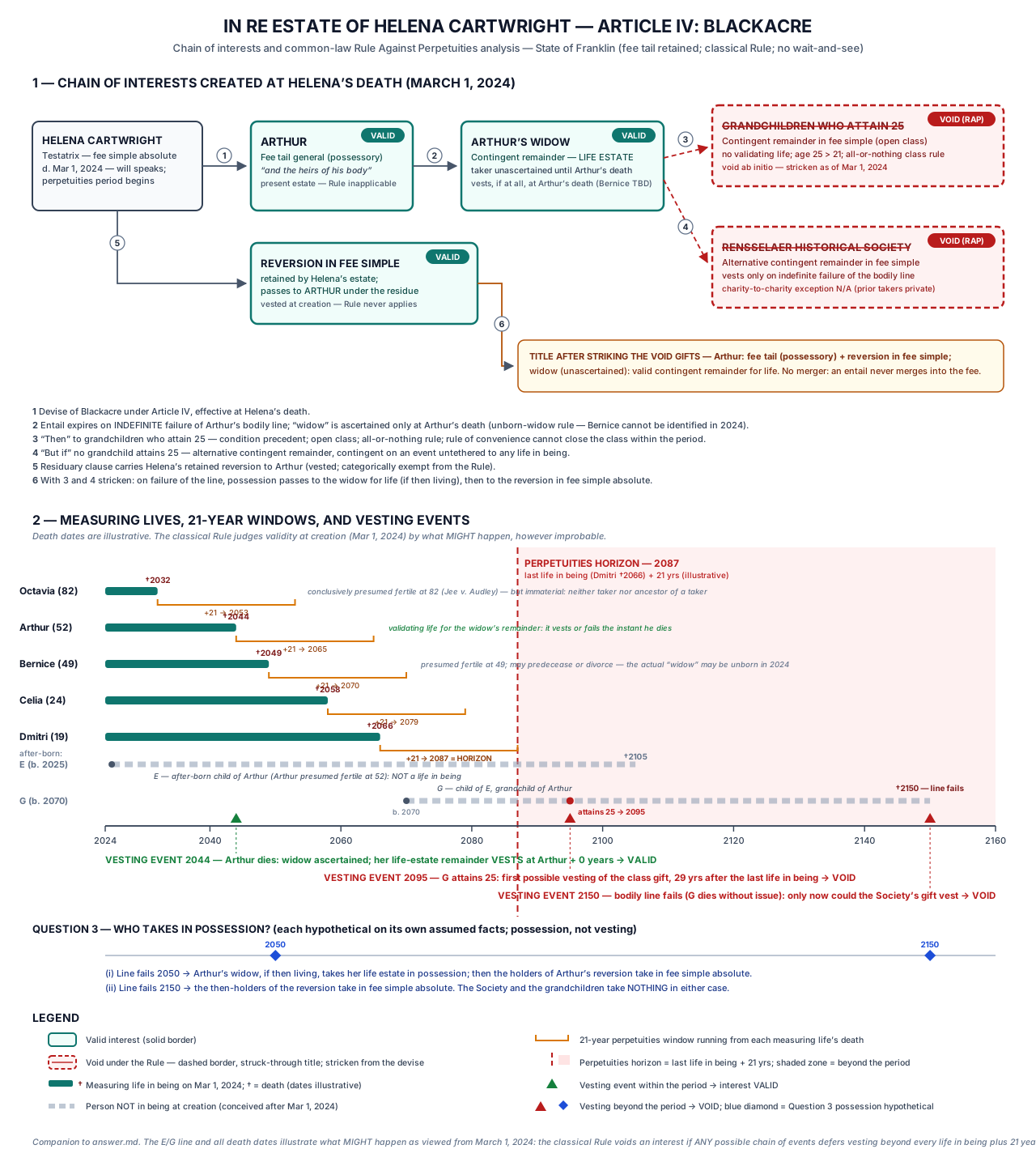
**ATTACHMENT:** `diagram.svg` (chain of interests and perpetuities timeline)

---

## Preliminary Note on Governing Law

Franklin is a common-law jurisdiction that (1) has never abolished the fee
tail, (2) retains the common-law Rule Against Perpetuities ("the Rule") in
its classical, what-might-happen form — no wait-and-see, no USRAP, no cy
pres reformation, (3) applies the conclusive fertility presumptions
(fertile octogenarian, unborn widow), and (4) construes class gifts under
the rule of convenience. Per the parties' stipulations, no disentailing
statute has been invoked, and the doctrine of worthier title and the Rule
in Shelley's Case are assumed inapplicable. All interests under Article IV
were created at Helena's death on **March 1, 2024** — the date the will
spoke and the date from which the perpetuities period is measured.

---

## Questions Presented

1. What present and future interests did Article IV create, in whom, and
   are the future interests vested or contingent? What effect does
   Franklin's retention of the fee tail have on the analysis?
2. Which contingent future interests satisfy the common-law Rule Against
   Perpetuities, measured from March 1, 2024 — including (a) whether
   Octavia's age and attested infertility excuse the fertile-octogenarian
   presumption, and (b) whether Bernice can be identified as Arthur's
   "widow" at Helena's death?
3. After void interests are stricken, what is the state of the title at
   Helena's death, and who takes if Arthur's bodily line fails in (i) 2050
   or (ii) 2150?

## Brief Answers

1. Article IV gives **Arthur a fee tail general in possession**. Because
   Franklin retains the fee tail, the words "and the heirs of his body"
   operate exactly as at common law, and the gifts over are **remainders**
   expectant on the indefinite failure of Arthur's bodily issue, not
   executory interests. The remainders are: a **contingent remainder for
   life in Arthur's widow** (contingent solely because she is
   unascertained); a **contingent remainder in fee simple, as a class,
   in Arthur's grandchildren who attain twenty-five**; and an
   **alternative contingent remainder in fee simple in the Rensselaer
   Historical Society**. Because every remainder in fee is contingent,
   Helena retained a **reversion in fee simple**, which passed under her
   residuary clause to **Arthur**.
2. The **widow's contingent remainder is valid** — it vests or fails at
   Arthur's death, and Arthur is his own validating life. The
   **grandchildren's remainder is void** *ab initio* — an after-born child
   of Arthur could produce a grandchild who attains twenty-five more than
   twenty-one years after every life in being has ended, and the
   all-or-nothing class-gift rule voids the entire class. The **Society's
   remainder is void** — it vests, if ever, only on the indefinite failure
   of Arthur's bodily line, an event untethered to any life in being.
   (a) Octavia's age and medical proof are **legally irrelevant**: the
   fertility presumption is conclusive at common law and irrebuttable by
   evidence — though the presumption that actually decides this case is
   the one applied to *Arthur and Bernice*, who at 52 and 49 are
   conclusively presumed capable of further children. (b) **No** —
   "widow" means the woman, if any, to whom Arthur is married at his
   death; Bernice's status cannot be determined until then, and the widow
   may prove to be a person not yet born in 2024.
3. After striking the void remainders, title stands: **fee tail general
   in Arthur** (possessory); **valid contingent remainder for life in
   Arthur's unascertained widow**; **reversion in fee simple in Arthur**
   (by residuary devise). (i) If the bodily line fails in **2050**,
   Arthur's surviving widow, if then living, takes a possessory life
   estate, and thereafter (or immediately, if no widow survives) the
   holders of the reversion — Arthur's successors in interest — take in
   fee simple absolute. (ii) If the line fails in **2150**, the result is
   the same in structure: the then-holders of the reversion take in fee
   simple absolute. **In neither scenario does the Historical Society or
   any grandchild take anything.**

---

## Discussion

### I. Classification of the Interests Created by Article IV

**Issue.** What estates and future interests did Article IV create at
Helena's death, and how does Franklin's retention of the fee tail shape
their classification?

**Rule.** Since the Statute De Donis Conditionalibus (1285), a devise "to
A and the heirs of his body" creates a **fee tail**: an estate of
inheritance that descends only to the donee's lineal (bodily) issue, *per
formam doni*, generation after generation, and expires naturally upon the
**indefinite failure of issue** — the extinction of the donee's entire
bodily line, whenever that occurs. In a jurisdiction retaining the fee
tail, language such as "if A's bodily line should ever fail" is construed
as referring to that indefinite failure, i.e., to the *natural expiration*
of the entail; limitations over that take effect at that expiration are
**remainders**, because they await the natural termination of the prior
freehold rather than divesting it. A remainder is **vested** if its taker
is ascertained and it is subject to no condition precedent other than the
termination of the preceding estates; it is **contingent** if the taker is
unascertained or a condition precedent must first be satisfied. Where the
limitations in fee following a freehold are all contingent, the grantor
(or testator's estate) retains a **reversion in fee simple**, a vested
interest by operation of law.

**Application.**

*Arthur.* "To my son Arthur and the heirs of his body" creates a **fee
tail general** in Arthur, possessory at Helena's death. This is the first
and most consequential effect of Franklin's retention of the fee tail: in
the great majority of American jurisdictions a statute would convert this
language into a fee simple (or a life estate with remainder to issue),
and the balance of Article IV would read very differently. In Franklin
the entail is given full common-law effect: on Arthur's death Blackacre
descends to his bodily heirs (presently Celia and Dmitri are the heirs
apparent of his body), and so on down the line until the line fails.

*Arthur's widow.* "If Arthur's bodily line should ever fail, then to such
person as shall be Arthur's widow for her life" creates a **remainder for
life**. The quoted condition is not a true condition precedent; it merely
restates the event on which the entail naturally expires. The remainder
is nonetheless **contingent**, for one reason only: the taker is
**unascertained**. "Arthur's widow" describes whoever is married to
Arthur at the moment of his death — an identity that cannot be known
until he dies. (Section II.A(b) addresses Bernice's claim.) Upon
Arthur's death the widow, if any, is ascertained, and her remainder
becomes **vested in interest** — expectant on the entail — even though it
may never become possessory, since possession awaits the failure of the
entire bodily line during her lifetime.

*Arthur's grandchildren.* "And then to those of Arthur's grandchildren
who shall attain the age of twenty-five years, in equal shares" creates a
**contingent remainder in fee simple in a class**. It is contingent
twice over: no grandchild of Arthur exists (Celia, 24, and Dmitri, 19,
are childless), and each taker must satisfy an express condition
precedent of attaining twenty-five. Had any member vested, the class
would have remained **subject to open** until the death of Arthur's last
child closed it physiologically.

*The Rensselaer Historical Society.* "But if no grandchild of Arthur
lives to attain the age of twenty-five, then to the Rensselaer Historical
Society ... forever" creates an **alternative contingent remainder in fee
simple absolute**. Its condition precedent is the exact mirror of the
grandchildren's: the two limitations are classic alternative contingent
remainders — one or the other, never both.

*The reversion.* Because every limitation in fee following the entail is
contingent, Helena's estate retained a **reversion in fee simple**,
vested from the moment of her death. Under the residuary clause ("all the
rest, residue, and remainder ... to Arthur outright"), that reversion
passed to **Arthur**. Two classification consequences follow. First, the
reversion is vested by definition and is therefore wholly outside the
Rule (Section II.D). Second, although Arthur now unites in himself the
fee tail and the reversion in fee, **no merger occurs**: it is settled
common law that an estate tail does not merge into the fee — De Donis
protects the entail and the expectancies built upon it — so the widow's
intervening contingent remainder is not squeezed out by merger or by the
destructibility doctrine at Helena's death.

**Conclusion.** At Helena's death Article IV created: (1) a fee tail
general in Arthur, possessory; (2) a contingent remainder for life in
Arthur's unascertained widow; (3) a contingent remainder in fee simple in
the open class of Arthur's grandchildren who attain twenty-five; (4) an
alternative contingent remainder in fee simple in the Society; and (5) a
reversion in fee simple, vested, passing by the residuary devise to
Arthur. Franklin's retention of the fee tail (a) validates the entail
itself, (b) makes the gifts over remainders on *indefinite* failure of
issue rather than executory interests on definite failure, (c) supplies
the centuries-long duration that drives the perpetuities analysis below,
and (d) by the no-merger rule preserves the widow's remainder despite
Arthur's acquisition of the reversion.

### II. The Rule Against Perpetuities

**The Rule.** "No interest is good unless it must vest, if at all, not
later than twenty-one years after some life in being at the creation of
the interest." Gray, *The Rule Against Perpetuities* § 201. For a
testamentary gift the period runs from the testator's death — here,
March 1, 2024. The Rule polices **vesting in interest, not possession**;
a vested interest may lawfully wait centuries for possession. In its
classical form the Rule is one of **possibilities**: an interest is void
*ab initio* if, viewed from the creation date, any imaginable chain of
events — however improbable — could postpone vesting beyond every life in
being plus twenty-one years. Class gifts are tested by the
**all-or-nothing rule** (*Leake v. Robinson*): if the interest of any
*possible* member of the class could vest remotely, the whole class gift
fails, even as to members whose interests would timely vest. The Rule
does not apply to reversions, to other vested interests, or to present
possessory estates. A "measuring" (validating) life is any person alive
at creation within whose life-plus-twenty-one-years the interest must
inevitably vest or fail.

#### II.A — The Widow's Contingent Remainder for Life: VALID

**Issue.** Must the widow's remainder vest or fail within a life in being
plus twenty-one years, and can Bernice be identified as the "widow" now?

**Rule.** A contingent remainder whose only contingency is the
ascertainment of the taker vests, if at all, at the moment of
ascertainment. Under the **unborn-widow presumption**, which Franklin
recognizes, a gift to a living man's "widow" may not be read as a gift to
his present wife: the marriage may end by divorce or her death, and the
man may later marry a woman **born after the testator's death**. The
widow is therefore unascertainable until the husband dies — but by the
same token she is necessarily ascertained, or the gift necessarily fails,
*at* his death.

**Application.** The single contingency on the widow's life estate is
ascertainment. At the instant of **Arthur's death** either some woman is
his surviving spouse — in which case the remainder vests in interest in
her at that instant — or no one is, and the remainder fails forever.
Arthur was alive on March 1, 2024. **Arthur is therefore his own
validating life**, and the latest possible vesting event is **Arthur's
death plus zero years** — comfortably within the period. That the widow
may herself be a person unborn in 2024 is irrelevant *to her own gift*,
because her interest does not depend on anything measured by *her* life;
the unborn-widow trap snaps shut only on gifts *after* the widow that are
keyed to *her* death (Section II.B notes its contributory role there).
Nor does the possibility that her estate never becomes possessory matter:
once ascertained she holds a vested remainder for life expectant on the
entail, and the Rule ignores postponed possession. One could object that
she takes only "if Arthur's bodily line should ever fail" — an event
perhaps centuries away — but that language merely marks the natural
expiration of the prior estate; it is not a condition precedent to
vesting, and a life tenant's implicit need to be alive at possession
defines the *duration* of a life estate, not its vesting.

**(b) Bernice.** Bernice's separate assertion that she "is" the widow
must be rejected as premature. "Such person as shall be Arthur's widow"
is a description answered only at Arthur's death. Bernice (49) may
predecease Arthur or be divorced; Arthur may remarry — conceivably a
woman born after March 1, 2024. **Bernice's identity as widow cannot be
determined at Helena's death.** She presently has, at most, the prospect
of qualifying; the contingent remainder exists in abeyance for whoever
answers the description. The court should decline to declare Bernice the
taker, while confirming that the widow's limitation itself is valid.

**Conclusion.** The widow's contingent remainder for life is **valid**.
Validating life: **Arthur**. Latest vesting event: **Arthur's death**.
Bernice cannot now be identified as the taker.

#### II.B — The Grandchildren's Class Remainder (Attain 25): VOID

**Issue.** Must the remainder to "those of Arthur's grandchildren who
shall attain the age of twenty-five years" vest or fail, as to every
possible class member, within lives in being plus twenty-one years?

**Rule.** A class gift conditioned on attaining an age greater than
twenty-one, where the class can admit members born of persons themselves
unborn at the creation of the interest, is the textbook remote gift.
Under the conclusive **fertility presumption** (*Jee v. Audley*), every
living person — regardless of age, sex, or medical condition — is
presumed capable of having children until death. Under the
**all-or-nothing rule**, one potentially remote member voids the class.
The **rule of convenience** (Andrews v. Partington) can sometimes rescue
a class gift by closing the class when some member becomes entitled to
demand distribution — but only if that closing must itself occur within
the period.

**Application.** Candidate validating lives are the persons in being on
March 1, 2024 connected to the gift: Arthur (52), Bernice (49), Celia
(24), Dmitri (19), and — for completeness — Octavia (82). None works.

*The invalidating chain.* (1) In 2025, Arthur and Bernice — or Arthur and
a later wife — have another child, **E**. E is *not* a life in being.
(Arthur at 52 is conclusively presumed fertile; that presumption, not
Octavia's, does the work here.) (2) In 2026, Arthur, Bernice, Celia,
Dmitri, and Octavia all die, extinguishing every life in being. (3)
Decades later E has a child, **G** — a grandchild of Arthur. (4) G
attains twenty-five well more than twenty-one years after 2026. G's
interest would vest too remotely; under the all-or-nothing rule the
**entire class gift is void**, including any share Celia's or Dmitri's
children might have taken. Indeed an even shorter chain suffices: Celia
bears a child G1 in 2025; every life in being dies in 2026; G1 attains
twenty-five in 2050 — twenty-four years beyond the last life in being.
The express age contingency of **twenty-five** — four years past the
common-law buffer — is fatal on these facts standing alone.

*No rescue available.* The rule of convenience cannot close the class
within the period: no grandchild can demand distribution until Arthur's
bodily line fails *and* the widow's life estate ends, and the failure of
the bodily line is precisely the event that may lie centuries off. The
physiological closing of the class (death of Arthur's last child) is
equally unbounded, since that last child may be the after-born E. And
the unborn-widow presumption compounds the remoteness: the preceding life
estate may be held by a woman unborn in 2024, so even distribution-stage
events cannot be tied to a life in being.

**(a) Octavia and the fertile-octogenarian presumption.** Octavia's
attested incapacity does **not** excuse the presumption. In its classical
form the fertility presumption is **conclusive and irrebuttable**;
medical testimony is inadmissible to qualify it. *Jee v. Audley* itself
presumed septuagenarians fertile, and Franklin expressly retains the
doctrine. Were Octavia's capacity material, the court would be bound to
presume her capable of bearing children at 82 notwithstanding thirty
years of menopause and her physicians' attestations. That said, the
court should note that Octavia's fertility is **immaterial to Article
IV**: she is neither a taker nor an ancestor of any taker, and her only
analytical role is as one more candidate measuring life (her life
validates nothing). The presumption that *decides* this case is the same
presumption applied to **Arthur and Bernice**: at 52 and 49 they are
conclusively presumed capable of producing the after-born child E on whom
the invalidating chain is built. Octavia is, in short, a decoy — but the
doctrine she personifies is dispositive elsewhere in the devise.

**Conclusion.** The grandchildren's remainder is **void ab initio**.
Validating life: **none exists** (Arthur, Bernice, Celia, Dmitri, and
Octavia all fail). Latest possible vesting event: attainment of
twenty-five by a grandchild born to an after-born child of Arthur — an
event with no temporal bound. The interest is stricken.

#### II.C — The Society's Alternative Contingent Remainder: VOID

**Issue.** Must the Society's remainder — "if no grandchild of Arthur
lives to attain the age of twenty-five" — vest or fail within the period,
and does any charity or fee-tail exemption save it?

**Rule.** An interest contingent on the indefinite failure of issue
violates the Rule unless tied to a validating life, because a bodily line
may persist through after-born generations indefinitely. The
**charity-to-charity exception** exempts a gift over from one charity to
another charity; it has no application where the preceding interests are
private. The classical books also recognize an exemption for
**limitations after estates tail** (Gray §§ 443–444): an interest that
must vest, if at all, no later than the expiration of an entail was held
exempt, on the rationale that the tenant in tail could at any moment
destroy it by suffering a common recovery or executing a disentailing
conveyance — so the interest imposed no practical clog on alienation.

**Application.** The Society's remainder vests in interest, at the
earliest, when it becomes certain that no grandchild of Arthur will ever
attain twenty-five, and at the latest at the failure of Arthur's bodily
line — the natural expiration of the entail. Neither event is anchored
to any life in being: the line may run through E, E's children, and
their children for two centuries (the 2150 hypothetical in Question 3 is
exactly such a case), every relevant actor having been born after 2024.
No candidate measuring life — Arthur, Bernice, Celia, Dmitri, Octavia —
validates the gift.

*The charitable exception fails.* The Society is a charity, but the
preceding limitations (fee tail in Arthur, widow's life estate,
grandchildren's remainder) are private. A gift over from private takers
to a charity enjoys no exemption; the exception requires charity on
*both* sides of the divesting line.

*The fee-tail exemption fails on these facts.* The Society's strongest
argument is Gray's exemption for limitations after estates tail, since
its interest must vest, if at all, no later than the entail's natural
expiration. The court should reject it. The exemption is parasitic on
**barrability**: it exists only because, and insofar as, the tenant in
tail can bar the remainders, rendering them illusory restraints. Here
the parties have invoked no disentailing statute, and the court has been
directed to treat the disentailment doctrines as inapplicable to this
construction. Where the entail cannot be barred, the exemption's
rationale evaporates, and limitations after the entail are tested by the
Rule in the ordinary way. (Were Franklin to recognize a freely available
disentailing mechanism, the exemption would furnish a respectable
argument for sustaining both gifts over; on the assumed record the court
need not, and should not, reach that question.) The same reasoning
disposes of any parallel argument on behalf of the grandchildren's class
gift, which is independently void under Section II.B in any event.

**Conclusion.** The Society's alternative contingent remainder is
**void ab initio**. Validating life: **none exists**. Latest possible
vesting event: the indefinite failure of Arthur's bodily line —
temporally unbounded. The interest is stricken.

#### II.D — Interests Not Subject to the Rule

Arthur's **fee tail** is a present, vested estate of inheritance; the
Rule has no application to it, and the succession of bodily heirs under
an entail has never been treated as a perpetuities problem — each heir in
tail takes by descent *per formam doni*, not by the vesting of a future
interest. The **reversion in fee simple** retained by Helena's estate
and devised to Arthur is vested from the moment of its creation;
reversions are categorically exempt. The **widow's remainder**, once she
is ascertained at Arthur's death, is vested and likewise beyond the
Rule's reach thereafter.

### III. State of the Title and the Two Failure Scenarios

**Issue.** What does the title look like once the void interests are
excised, and who takes on failure of the bodily line in 2050 and in 2150?

**Rule.** Void interests are stricken as of the testator's death and the
instrument is read as if they had never been written. Striking a
remainder does not accelerate or enlarge other limitations beyond their
terms; the gap is filled by the reversion, which takes effect in
possession on the natural expiration of the preceding valid estates.

**Application — title at Helena's death (March 1, 2024).** Reading
Article IV with the grandchildren's and Society's remainders deleted:

1. **Arthur** — fee tail general, in possession.
2. **Arthur's widow (unascertained)** — contingent remainder for life,
   valid; vests in whoever survives Arthur as his wife.
3. **Arthur** — reversion in fee simple absolute (vested), taken under
   the residuary clause; no merger with the entail, so the widow's
   remainder stands (Section I).
4. **Celia, Dmitri, future grandchildren, and the Society** — nothing
   under Article IV. Celia and Dmitri hold no devised interest; their
   expectancy is to inherit the entail as heirs of Arthur's body. The
   guardian ad litem's wards take nothing because the class gift is void
   as to all possible members; the Society's claim fails entirely.

**Scenario (i): the bodily line fails in 2050.** The entail cannot fail
while Arthur lives; so by hypothesis Arthur has died before 2050 (his
widow, if any, was ascertained at his death — Bernice if she was then his
wife and survived him), and his last bodily descendant dies in 2050. At
that moment the entail expires. If the **widow is then living**, her
remainder — long since vested in interest — takes effect **in possession
as a life estate**; on her death, the **reversion in fee simple absolute
falls into possession** in the hands of Arthur's successors in interest
(the devisees or heirs through whom the reversion has passed from
Arthur's estate). If **no widow survives** to 2050, the reversion takes
effect in possession immediately upon the failure of the line. The
Society takes nothing, even though no grandchild of Arthur may ever have
reached twenty-five: its gift was void from March 1, 2024, and events
since cannot revive it — the classical Rule judges possibilities at
creation, not actualities.

**Scenario (ii): the bodily line fails in 2150.** The analysis is
identical in structure and starker in result. By 2150 the widow —
whoever she proved to be — will in all probability have died long since;
if so, her life estate simply expired without (or after) possession, and
upon the failure of the line the **then-holders of the reversion take
Blackacre in fee simple absolute**. Those holders are whoever succeeded,
by will or intestacy through the intervening century, to the reversion
Arthur took under Helena's residuary clause. (In the strict logical case
that a widow of Arthur were still alive in 2150, she would take her life
estate first, with the reversion following — the structure does not
change.) Again, **neither the Society nor any grandchild takes**. The
2150 hypothetical illustrates *why* the Rule struck these gifts: it is
precisely the possibility that the curtain would not rise until 2150 —
126 years after every 2024 life could have ended — that made the
grandchildren's and Society's interests void on day one.

**Conclusion.** Title at Helena's death: fee tail general in Arthur;
valid contingent remainder for life in Arthur's unascertained widow;
reversion in fee simple in Arthur via the residue. On failure of the
bodily line in 2050: the surviving widow, if living, for life, then
Arthur's reversion-successors in fee simple absolute; if no widow, the
reversion-successors at once. On failure in 2150: the
reversion-successors in fee simple absolute (subject to the theoretical
priority of a still-living widow's life estate). The Historical
Society's claim should be denied in toto.

---

## Recommendation

The court should declare: (1) Arthur holds Blackacre in fee tail general,
together with the reversion in fee simple devised by the residuary
clause; (2) a valid contingent remainder for life exists in such person
as shall be Arthur's widow, who cannot now be identified and as to whom
Bernice's claim is premature; (3) the remainders to Arthur's
grandchildren and to the Rensselaer Historical Society are void under the
Rule Against Perpetuities and are stricken; and (4) upon the failure of
Arthur's bodily line at any time, possession passes to the surviving
widow for life, if any, and then to the holders of the reversion in fee
simple absolute. A short decree to that effect, with the attached
diagram appended as a visual aid, is recommended.

*Attachment: `diagram.svg` — chain of interests, measuring lives,
perpetuities windows, and vesting events.*