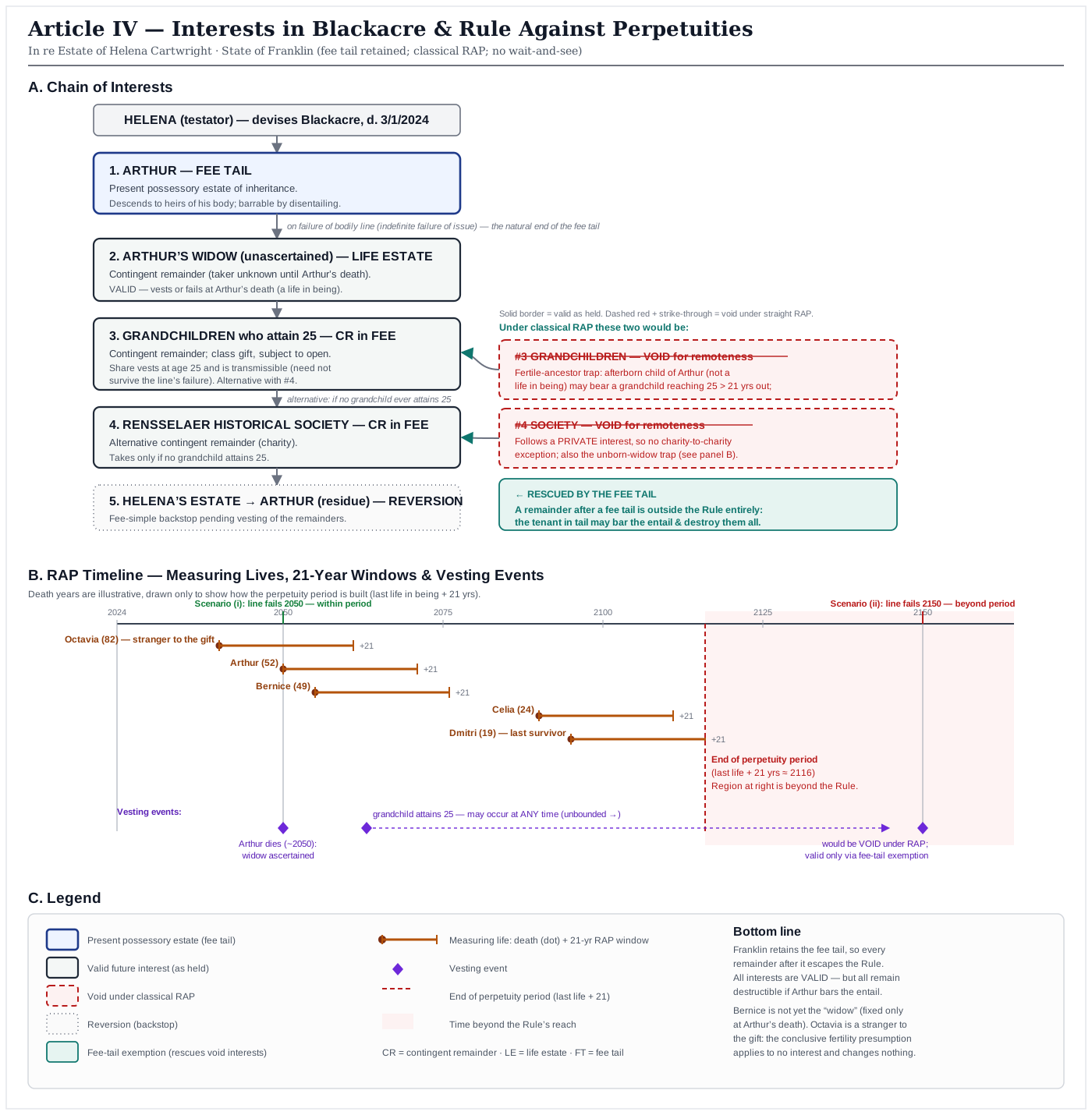
issue 001 · campaign EV-023
# MEMORANDUM

**TO:** The Honorable Judge, Probate Court of Franklin County
**FROM:** Law Clerk
**RE:** *In re Estate of Helena Cartwright* — Construction of Article IV of the Will and Declaration of Title to Blackacre
**DATE:** June 11, 2026

---

## I. Summary of Conclusions

Article IV devises Blackacre to Arthur in **fee tail**, followed by a string
of remainders: a contingent life estate in Arthur's widow, an alternative pair
of contingent remainders in fee (to Arthur's grandchildren who reach 25, or
failing that to the Rensselaer Historical Society), with a reversion in
Helena's estate as a backstop.

The single most consequential fact in this case is that **Franklin has retained
the fee tail in its classical form.** That retention is dispositive. At common
law a remainder limited after a fee tail is **not subject to the Rule Against
Perpetuities**, because the tenant in tail may at any moment bar the entail and
destroy every interest expectant upon it. Were it not for that exemption, the
gifts to the grandchildren and to the Society would both be **void** for
remoteness — the grandchildren's gift falling to the fertile-ancestor and
unborn-widow traps, the Society's gift falling with it (the charity-to-charity
exception does not reach a charitable gift that follows a *private* interest).
Because Franklin keeps the fee tail, all of these interests are **valid**,
though all remain destructible by Arthur's exercise of the disentailing power.

Bernice is **not** "Arthur's widow" and holds no present interest; a widow is
ascertained only at the husband's death. Octavia is a **stranger to every
limitation** in Article IV; her age and medical condition are legally
irrelevant, and the conclusive common-law presumption of lifelong fertility —
which her physicians' attestation cannot rebut — has nothing to operate upon.

---

## II. Issue One — Classification of the Interests

### Issue

What present and future interests does Article IV create; who takes each; is
each future interest vested or contingent; and what is the legal effect of
Franklin's retention of the fee tail?

### Rule

A devise "to A and the heirs of his body" is the classic limitation creating a
**fee tail** — "heirs of his body" are words of *limitation* (marking the
quantum of A's estate), not words of *purchase* (naming takers). A fee tail is
a freehold estate of inheritance that descends to the tenant's lineal issue
and endures until the tenant's bodily line is exhausted — an **indefinite
failure of issue**, which at common law is the natural and only termination of
the estate. A gift over that awaits that natural termination is a **remainder**,
not an executory interest, because it does not cut the prior estate short.

A remainder is **contingent** if (i) the taker is unascertained, or (ii) it is
subject to a condition precedent. A remainder is **vested** when the taker is
ascertained and no condition stands before possession but the natural
expiration of the prior estates. A class gift is "subject to open" while
additional members may yet be born.

The tenant in tail in possession holds the **power to disentail** — historically
by common recovery, in modern practice by disentailing assurance — converting
the fee tail into a fee simple absolute and **destroying all remainders and
reversions expectant on the entail.**

### Application

**1. Arthur — Fee Tail (present possessory estate).**
"To my son Arthur and the heirs of his body" is the textbook fee tail. Because
Franklin has never abolished the estate, the words operate at face value:
Arthur takes a present possessory fee tail, which on his death will pass to the
heirs of his body (his issue *per stirpes*) and continue down his bloodline
until that line fails. Arthur is **not** a fee-simple owner and **not** a mere
life tenant; he is tenant in tail, and as tenant in tail in possession he holds
the power to bar the entail (see Issue Two, which explains why this power is the
hinge of the whole case).

**2. Arthur's widow — Contingent Remainder for life (a life estate).**
"To such person as shall be Arthur's widow for her life" creates a remainder
for life. It is **contingent** because the taker is unascertained: the identity
of "Arthur's widow" cannot be known until Arthur dies (see Issue Two(b)). It
becomes vested in interest, or fails, at Arthur's death, when we learn who — if
anyone — survives him as his widow.

**3. Arthur's grandchildren who attain 25 — Contingent Remainder in fee
simple (class gift, subject to open).**
"Then to those of Arthur's grandchildren who shall attain the age of
twenty-five years, in equal shares" is a remainder to a class. It is
**contingent** on three counts: at Helena's death **no grandchild yet exists**
(Celia and Dmitri are childless), so the takers are wholly unascertained; each
share is subject to the **condition precedent of attaining 25**; and the class
is **subject to open**, because Arthur (and his children) may yet produce
grandchildren. Critically, a grandchild's share **vests when that grandchild
reaches 25** and is then **transmissible** — the grandchild need not survive the
eventual failure of Arthur's line. This dissolves the apparent paradox that
grandchildren are themselves "heirs of Arthur's body": the gift runs to the
*estates* of grandchildren who reached 25, even though, by the time the bodily
line is finally exhausted, those grandchildren will themselves be dead.

**4. Rensselaer Historical Society — Alternative Contingent Remainder in fee
simple.** "But if no grandchild of Arthur lives to attain the age of
twenty-five, then to the Rensselaer Historical Society . . . forever." The
Society's gift and the grandchildren's gift are the two halves of a single
**alternative contingent remainder**: one or the other must take. The Society is
an ascertained taker, but its interest is subject to the **condition precedent**
that *no* grandchild ever attains 25; it is therefore contingent.

**5. Helena's estate (passing to Arthur under the residuary clause) —
Reversion in fee simple.** Because the remainders following the fee tail are all
contingent, the grantor's estate retains a reversion in fee simple as a
technical backstop pending vesting. Helena's residuary clause carries that
reversion to Arthur. (The reversion does not *merge* into Arthur's fee tail — a
fee tail is a distinct estate of inheritance — but Arthur's ownership of both
fortifies his practical ability to take a fee simple absolute by disentailing.)

**Legal effect of the fee tail.** Retention of the fee tail does three things.
(a) It fixes Arthur's estate as a fee tail, not a fee simple, so the gifts over
are genuine remainders rather than void attempts to limit after a fee simple.
(b) It vests in Arthur (and his issue in tail) the power to disentail and defeat
every interest below him. (c) Most importantly, it brings the subsequent
remainders within the common-law **exemption of post-fee-tail remainders from
the Rule Against Perpetuities** — the point developed in Issue Two. Had Franklin
abolished the fee tail (as most jurisdictions have, converting "heirs of the
body" into a fee simple, a fee simple conditional, or a life estate plus
remainder), that exemption would not apply and the gifts over would be tested —
and, as shown below, struck — under the classical Rule.

### Conclusion

Article IV creates: a **fee tail** in Arthur; a **contingent remainder for
life** in Arthur's unascertained widow; **alternative contingent remainders in
fee** in (a) Arthur's grandchildren who attain 25 (class gift, subject to open)
and (b) the Rensselaer Historical Society; and a **reversion in fee simple** in
Helena's estate, which passes to Arthur under the residuary clause.

---

## III. Issue Two — The Rule Against Perpetuities

### Issue

Applying the classical common-law Rule, is each contingent future interest
valid or void? For each, what are the measuring lives and the latest possible
vesting event? Specifically: (a) does Octavia's age or medical condition excuse
the fertile-octogenarian presumption, and (b) can Bernice's status as "widow"
be fixed at Helena's death?

### Rule

**The Rule.** "No interest is good unless it must vest, if at all, not later
than twenty-one years after some life in being at the creation of the interest."
(Gray, *The Rule Against Perpetuities*.) Validity is judged **as of the creation
of the interest** — here, Helena's death — by the **"what-might-happen" test**:
if there is *any* conceivable chain of events, however unlikely, in which the
interest could vest beyond the perpetuity period, it is void. Franklin has not
adopted USRAP or wait-and-see, so **actual events are irrelevant**; we may not
"wait and see" whether the interest in fact vests in time.

**The fee-tail exemption.** A remainder limited after an estate tail — vested or
contingent — is **not subject to the Rule Against Perpetuities.** The reason is
the disentailing power: because the tenant in tail can at any instant bar the
entail and extinguish every interest expectant upon it, those interests do not
offend the Rule's policy against remote fettering of land. Gray so states; the
Restatement (First) of Property recognizes the same exemption. The interest is
treated as good however remote its vesting, precisely because it is always
destructible by the present tenant.

**The fertile-octogenarian presumption.** At common law the capacity to bear
children is conclusively presumed to continue throughout life, regardless of
age or proven sterility. The presumption is **irrebuttable**; medical evidence
of infertility is **inadmissible**. *Jee v. Audley* (1787) is the fountainhead:
a gift was struck on the assumption that a couple "of a very advanced age" might
yet have children. Franklin, by its terms, retains this presumption.

**The unborn-widow presumption.** A gift to a named person's "widow" refers to
whoever is married to him *at his death*. Her identity cannot be known until
then, and the law presumes she **may be a person not yet in being** at the
creation of the interest — the husband may divorce and remarry, or outlive his
present spouse and marry someone born after the testator's death. The
"unborn widow" therefore **cannot serve as a measuring life.**

### Application

#### Threshold: the fee-tail exemption controls — these interests are valid.

Every future interest in Article IV is a **remainder limited after Arthur's fee
tail.** The widow's life estate is a remainder awaiting the natural termination
of the tail; the grandchildren's and the Society's remainders are limited after
the widow's life estate, and so are likewise expectant on the tail and equally
destructible if Arthur (or any tenant in tail in possession) bars the entail.
Because **post-fee-tail remainders are exempt from the Rule**, the Rule does not
reach any of them. **All three contingent remainders are valid.**

That conclusion is the legal answer. But to show the judge what is at stake in
the fee-tail exemption — and because the Court has asked for the measuring lives
and latest vesting event of each interest — I set out below how each interest
would fare *if the Rule applied*, i.e., if Franklin had abolished the fee tail.

#### (1) The widow's contingent life estate — valid even on a straight RAP analysis.

- **Measuring life:** Arthur.
- **Latest vesting event:** Arthur's death, when his widow (if any) is
  ascertained.
- **Analysis:** This remainder is contingent only because the taker is
  unascertained. The identity of "Arthur's widow" is necessarily fixed **at
  Arthur's death**, and Arthur is a life in being at Helena's death. The
  contingency therefore resolves within a life in being plus zero years. The
  unborn-widow trap does **not** void the widow's *own* interest — it bites the
  interest that *follows* her life estate.
- **Conclusion:** **Valid** under the Rule, and *a fortiori* valid under the
  fee-tail exemption.

#### (2) The grandchildren's contingent remainder — VOID under a straight RAP analysis; saved here only by the fee-tail exemption.

- **Candidate measuring lives:** Arthur and his now-living children, Celia and
  Dmitri. None validates the gift.
- **Latest vesting event:** a grandchild attaining 25 — with no temporal ceiling.
- **Analysis:** Two independent classical traps defeat this gift.
  - **The fertile-ancestor trap.** Arthur (age 52) is conclusively capable of
    having more children. A child of Arthur **born after Helena's death** is not
    a life in being. That afterborn child could in turn have a child — a
    grandchild of Arthur — who attains 25 **more than 21 years after the death of
    everyone alive at Helena's death.** Because the class stays open to such
    afterborn grandchildren, the gift can vest too remotely. (One need not even
    resort to the octogenarian fiction; Arthur is in fact of childbearing age.)
  - **The unborn-widow trap.** The grandchildren's remainder follows the widow's
    life estate and, on its natural reading, the grandchildren take in
    possession at the widow's death. The widow may be a person **not in being**
    at Helena's death (see (b) below). Her death could fall more than 21 years
    after all lives in being, so any grandchild's interest measured from it
    vests too late.
  - The **rule of convenience** does not save the gift: the class closes only
    when a grandchild is first entitled to possession, which is deferred until
    the remote failure of issue and the widow's death — too late to cure the
    remoteness.
- **Conclusion:** **Void** under the classical Rule. **But valid here**, because
  as a remainder after a fee tail it is exempt from the Rule altogether.

#### (3) The Society's alternative contingent remainder — VOID under a straight RAP analysis; saved here only by the fee-tail exemption.

- **Measuring lives:** the same as (2); none validates the gift.
- **Latest vesting event:** the moment it becomes certain that no grandchild
  will ever attain 25 — equally unbounded.
- **Analysis:** The Society's gift is the mirror image of the grandchildren's
  and turns on the same remote contingencies; it can fail to vest within the
  period for the same reasons. The **charity-to-charity exception** does **not**
  rescue it: that exception exempts a charitable gift only where it divests
  *another charity*. Here the Society's interest follows a **private** interest
  (the grandchildren), so the exception is unavailable.
- **Conclusion:** **Void** under the classical Rule. **But valid here** under the
  fee-tail exemption.

#### (a) Octavia — the fertile-octogenarian presumption changes nothing.

The presumption is **conclusive and irrebuttable**: a court may not receive the
physicians' attestation that Octavia, at 82 and thirty years menopausal, is
biologically incapable of bearing children. *Jee v. Audley.* Franklin retains
the presumption, so her medical condition does **not** excuse it.

But the presumption has **nothing here to operate upon.** Octavia is Helena's
*sister*. She takes nothing under Article IV; she is not an ancestor of any
taker; and she is not a measuring life for any interest. Whether she is treated
as fertile or barren, **no interest in Blackacre is affected.** The fertility
that actually matters is **Arthur's** (and his children's), and Arthur needs no
presumption — at 52 he is plainly capable of issue. Octavia is a distractor: the
conclusive presumption is correctly stated, but it does no work in this case.

#### (b) Bernice — "widow" cannot be determined at Helena's death.

**No.** A "widow" is the woman married to the man at the moment of his death.
Bernice is Arthur's **present wife**, not his widow. She may predecease him;
the marriage may end; Arthur may remarry. The person who answers to "Arthur's
widow" is therefore **unascertained** until Arthur dies, and the law presumes
she may even be someone **not yet born** at Helena's death. Bernice accordingly
holds **no present interest** — only a mere expectancy — and her appearance
claiming the life estate as the current spouse is premature. The widow's life
estate is a contingent remainder in an unascertained person, to be filled, if
at all, only at Arthur's death.

### Conclusion

Under the classical Rule the **widow's life estate is valid**, but the
**grandchildren's and the Society's remainders would both be void** for
remoteness. Because Franklin retains the fee tail, however, **all three are
remainders after a fee tail and are exempt from the Rule** — and so **all three
are valid.** Octavia's age and medical condition are immaterial (the
presumption is conclusive but inapplicable), and Bernice's identity as "widow"
cannot be fixed until Arthur's death.

---

## IV. Issue Three — State of the Title and Distribution Scenarios

### Issue

After striking any void interest, what is the state of the title at Helena's
death, and who takes if Arthur's bodily line fails in (i) 2050 and (ii) 2150?

### Rule

Strike only interests void under the controlling law. Surviving contingent
remainders leave a reversion in the grantor pending vesting. Distribution on the
failure of the fee tail follows the order of the limitations, subject always to
the tenant in tail's power to have barred the entail beforehand.

### Application

**State of the title at Helena's death (March 1, 2024).** Because the fee-tail
exemption validates every interest, **nothing is struck.** Title stands as
follows:

| Holder | Interest |
| --- | --- |
| **Arthur** | Fee tail in possession |
| **Arthur's widow** (unascertained) | Contingent remainder for life |
| **Arthur's grandchildren who attain 25** | Contingent remainder in fee (class, subject to open) — alternative with the Society |
| **Rensselaer Historical Society** | Alternative contingent remainder in fee |
| **Helena's estate → Arthur (residue)** | Reversion in fee simple (backstop) |

Two caveats govern both scenarios. First, **Arthur (or any later tenant in tail
in possession) may bar the entail** at any time before the line fails; if he
does, he takes a fee simple absolute and the widow, the grandchildren, and the
Society take **nothing.** The scenarios below assume the entail was never barred.
Second, distribution presupposes that the bodily line has in fact failed — i.e.,
that no living descendant of Arthur remains.

**(i) Arthur's bodily line fails in 2050.** The fee tail ends. In order:
1. **Arthur's widow**, if she is then living, takes possession of a **life
   estate.** (Her identity was fixed at Arthur's death; she takes only if she
   survives to the failure of the line. If she predeceased the failure, her
   life estate simply never falls into possession and we proceed to the next
   taker.)
2. On the widow's death (or at once, if no widow then survives), the land passes
   to **those of Arthur's grandchildren who have attained 25**, in equal shares —
   including the transmissible shares of any such grandchild who reached 25 and
   has since died. If **no** grandchild ever attained 25, the **Rensselaer
   Historical Society** takes in fee simple.
   2050 lies within the period that the Rule would have policed (Arthur, born
   1972, will almost certainly have died by then, and 2050 is within roughly a
   life in being plus 21 years). That timing matters only as a contrast: the
   interests are valid not because they happen to vest early but because the
   fee-tail exemption removed them from the Rule's reach entirely.

**(ii) Arthur's bodily line fails in 2150.** The order of takers is identical:
1. **Arthur's widow** — but by 2150 she is, as a practical certainty, long dead.
   Her life estate therefore **never falls into possession** and is bypassed.
2. The land passes to **the grandchildren who attained 25** — meaning, in 2150,
   to the **successors, devisees, and heirs of those grandchildren**, since the
   grandchildren themselves will be dead. If **no** grandchild ever attained 25,
   the **Rensselaer Historical Society** takes in fee simple.
   The decisive point: **2150 is centuries beyond any life in being at Helena's
   death plus 21 years.** Under the classical Rule a gift vesting then would be
   void. It is good here **only because the fee-tail exemption takes these
   remainders outside the Rule.** Scenario (ii) is the precise demonstration of
   the exemption's effect: the same gift that the Rule would strike for vesting
   in 2150 is valid in Franklin because it follows a fee tail.

### Conclusion

At Helena's death, Arthur holds a **fee tail**; his unascertained widow holds a
**contingent remainder for life**; his grandchildren who attain 25 and the
Society hold **alternative contingent remainders in fee**; and Helena's estate
holds a **reversion** that passes to Arthur. Nothing is struck. Whether the line
fails in **2050 or 2150**, the takers are the same — the widow (if living) for
life, then the grandchildren who reached 25 (or their successors), and failing
any such grandchild, the Society — subject always to the possibility that the
entail was barred along the way, in which case the tenant in tail took a fee
simple absolute and the gifts over were destroyed.

---

## V. Recommendation

The Court should enter a declaration that **Arthur takes a fee tail**, that
**Bernice has no present interest** (a widow being ascertained only at Arthur's
death), and that the **gifts over to the widow, to the grandchildren who attain
25, and to the Society are valid contingent remainders** — saved from the Rule
Against Perpetuities by Franklin's retention of the fee tail and its attendant
disentailing power — with a **reversion** in Arthur under the residuary clause.
The guardian ad litem's claim on behalf of the grandchildren should be sustained
as a contingent (not present) interest; Bernice's claim should be denied as
premature; and the Society's claim should be recognized as a valid alternative
contingent remainder.

*Respectfully submitted,*
*Law Clerk to the Probate Court of Franklin County*
This is the exhibit to sit with. The diagram is, by the judge's own mark, flawless — a clean chain of title, the measuring lives laid out, the perpetuities windows drawn true, a five out of five. And it is a flawless picture of a holding that is wrong.
What makes it worth your attention is not that the model failed — a weaker model failing is unremarkable — but *how* it failed. Opus 4.8 classified every interest correctly: the fee tail, the contingent remainders, the unborn-widow trap, the irrebuttable octogenarian presumption. It demonstrated, in its own hypotheticals, that it saw the traps. Then it adopted a single wrong premise — that a remainder following a fee tail is exempt from the Rule Against Perpetuities — and that one premise overrode everything it knew, turning two void gifts valid and carrying the error straight through to the final title. The reasoning did not break for lack of knowledge. It broke because one confident, wrong commitment propagated down a chain where every link depends on the last.
The reason this matters to anyone relying on these tools: this is the failure mode that does not announce itself. A garbled answer you catch on sight. A beautifully drafted, internally consistent, professionally typeset wrong answer is the one that gets waved through — and it is precisely what a more capable model produces when it errs. The lesson is not "do not trust the machine." It is narrower and more useful: trust is allocated per task, not per brand or per version. The newest flagship was the one that drew this. Verify the specific work.